

Welcome to the end of the Gospels chapter 8:1-8. Let us enter the book of John, the Beloved.

But Jesus went to the Mount of Olives.
2 Now early in the morning He came again into the temple, and all the people came to Him; and He sat down and taught them.
Jesus frequently went into the temple and taught the people who gathered there. His ministry was not done in secret, and neither should ours!

3 Then the scribes and Pharisees brought to Him a woman caught in adultery. And when they had set her in the midst, 4 they said to Him, “Teacher, this woman was caught in adultery, in the very act.”
Here come the religious leaders, dragging a trembling woman into the midst of Jesus’s teaching. Note how they plan to catch Jesus with the law of Moses.
And when they had set her in the midst, 4 they said to Him, “Teacher, this woman was caught in adultery, in the very act. 5 Now Moses, in the law, commanded us that such should be stoned. But what do You say?”

Was the woman dragged from the bed, clutching a sheet? Did they allow her to grab her robe? Her hair was probably loose, uncustomary for that culture. Full of shame, fear, consternation, maybe? I’m sure she already knew the law and consequences. I’m sure she did not know the compassion Jesus had for her, a sinner.
6 This they said, testing Him, that they might have something of which to accuse Him. But Jesus stooped down and wrote on the ground with His finger, as though He did not hear.
Jesus spoke without a word. He knew their hearts as well as He knew the Laws of Moses. We all wonder exactly what Jesus was writing with His finger in the dirt.
7 So when they continued asking Him, He raised Himself up and said to them, “He who is without sin among you, let him throw a stone at her first.” 8 And again He stooped down and wrote on the ground.

We all know what happens next. The leaders turned around and left, in shame. It began with the elders, ending with the youngest. I assumed because the eldest had more time to rack up sins.
Jesus asked the woman where her accusers were. They all left! He told her that he did not condemn her [see John 3:17] but warned her to go and sin no more.
One question that arises: Where was the other half of the adulterous couple? Was he one of the leaders?

This passage of Scripture sets many people free, especially women in Muslim communities. Jesus was demonstrating the value God puts on women. Many cultures and religions put no value on women. Note: one false version of the Bible ends this story with Jesus killing this woman because he was the one without sin, giving him the onus to stone her to death.
This brings me to my reading from yesterday’s devotions, Matthew chapter 7. I think judgement is the crux of John chapter 8. as well as Matthew 7.
Do Not Judge
Matthew 7:1“Judge not, that you be not judged. 2 For with what judgment you judge, you will be judged; and with the measure you use, it will be measured back to you. 3 And why do you look at the speck in your brother’s eye, but do not consider the plank in your own eye? 4 Or how can you say to your brother, ‘Let me remove the speck from your eye’; and look, a plank is in your own eye? 5 Hypocrite! First remove the plank from your own eye, and then you will see clearly to remove the speck from your brother’s eye.

All of us have been guilty of transgressing the law at some point in our lives. When we humble ourselves, we can see clearly. Religious piety is normal for our human bent. We experience something of God and the Spirit, then we want to hold onto it. We make it a dogma to follow.
Humanity loves having boundaries. The freedom we get from Christ and the love of God can make us uneasy. It’s much easier to have rules to follow and parameters to hold us in although, we also want to push those boundaries. Pay attention to what brings judgmental thoughts to your mind; it is probably your plank.

Coming back to Matthew 7, we like to judge those who are different, who are doing something/being something we don’t think is right. We must be careful to have a true estimation of who we are in light of Christ and God’s love.
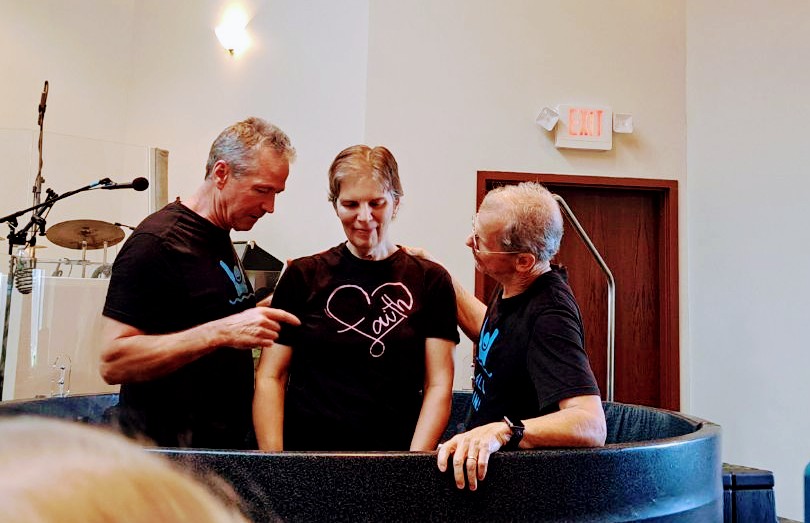
All of us are guilty, bound for judgement by a righteous God. We have forgiveness in Jesus. Do not take it lightly! Extend it to others as you speak the truth in love. You want mercy and forgiveness, so does the one you are condemning by your thoughts/words/ actions. I leave you with these thoughts. The photo is me, getting ready to identify with Christ’s death and resurrection in baptism. I pray you get time to seek the LORD and find His Shalom. Until next time, be a blessing as you are blessed by God!

 Peter was not writing just to these pilgrims, but also to those of us who have come after. All of us who are Believers are part of the elect according to God’s foreknowledge of us. The Spirit sanctifies us, accomplished in us by obedience and the sprinkling of the blood of Jesus Christ. As we walk in obedience and sanctification, grace and peace multiply in our lives. Do you believe He sanctifies you; not by works of righteousness you have done, but according to Father God’s mercy? Let’s dig into the Heavenly inheritance we have.
 Our Father God has blessed us with abundant mercy in our Lord Jesus Christ. We have a living hope that will never end; it’s living and growing in us daily. Halleluiah, the power of God shall keep us through faith; which comes from God and grows in us. Therefore, we have hope. Why do we rejoice?
 We rejoice in this salvation even as we find grief in these trials all around us. These trials come to test our faith, its goal found in Jesus Christ. Blessed is he that has not seen Christ, but loves Him anyway. What inexpressible joy comes as we trust Jesus! The prophets and angels wonder.
 Our hope rests in the grace brought to us with the revelation of Jesus Christ in us. This grace increases as we obey and turn away from fleshly lusts and ignorance. We all wonder how to become holy as He is; it comes from communion with the Lord and walking daily in His presence.
 This paragraph explains the worth of our lives in view of Christ’s sacrifice. God’s work which gave our Messiah glory empowers us to put faith and hope in God. The last section of this chapter explains the endurance of God’s Word and what glory there is in the Gospel and reason for spreading it far and wide!
 Musings along life's journey